
The Small Towns That Bet Big on Monsters—and Won
Bigfoot, Mothman, and other unique local cryptids are fueling a mini tourism boom across America.
The most famous resident of Point Pleasant, West Virginia, is 11 feet tall and fully nude. He bears no race, no creed, and no visible genitals—only the blank stare of someone who doesn’t believe in math. Also, he’s got a chrome tush that could snap a tree limb in half.
He is the Mothman statue of Point Pleasant, West Virginia, a beacon of cheek presiding nudely over the town of just under 4,000. And he rakes in millions of tourism dollars each year.
Every September, tens of thousands of tourists descend on Point Pleasant for its annual Mothman Festival, a three-day event that celebrates the town’s resident cryptid. They come for the costume contests and the chilling eyewitness panels; they stay to caress the statue’s formidable chrome buttocks, curving pert and precious beneath a pair of intricately carved moth wings. They also spend their hard-earned dollars up and down Point Pleasant’s quaint main drag.
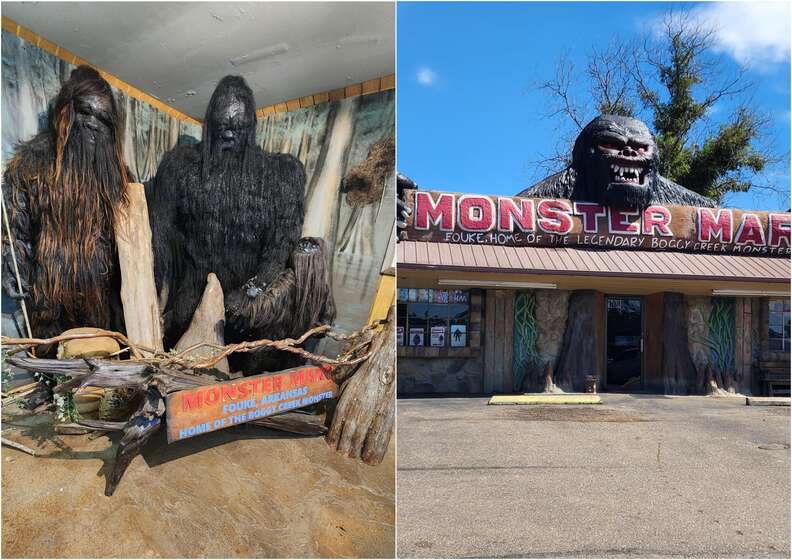
Meanwhile, in Fouke, Arkansas, road trippers venture hours out of their way to visit the Fouke Monster Mart and roadside pizza joint. Burlington, Vermont, profits off of its apocryphal lake monster with extensive collegiate baseball merch. Churubusco, Indiana is the alleged birthplace of a monstrous turtle known as the Beast of Busco; lacking the infrastructure for a giant turtle museum, Churubusco celebrates its past via the annual Miss Turtle Days pageant. As population loss accelerates in rural America, these towns are all tapping into a lucrative truth: People love a good scare—especially one they can wear on a T-shirt.
Denny Bellamy, a lifelong Point Pleasant resident, is the longtime tourism director for Mason County, where Point Pleasant is located. He says the Mothman Festival costs the town up to $50,000 in overtime staffing, which is pocket change compared to the weekend’s profits. “It’s still a multi-million dollar event,” he says. “It’s like Christmas in Point Pleasant.”

The 2024 festival brought in close to $5 million and as many as 45,000 out-of-town visitors, according to Bellamy’s estimates. And while the short-term economic boost is great, locals benefit even more from year-round Mothman tourism, which includes visits to the town’s flagship Mothman Museum.
Bellamy adds that, while the legend is absolutely the town’s main source of tourism, it drives visitors to the town’s other attractions, including a main street lined with murals and stunning natural scenery. “People come here for the festival, but they’ll make a second trip to Point Pleasant to visit the town and see everything here with no lines,” Bellamy says. “They get to eat in our restaurants and shop in our gift shops.”
Now, he adds, there’s a waiting list to rent a storefront on Main Street, and younger residents are staying in town to get their piece of the Mothman pie. “The younger generation who grew up with [Mothman] are the ones opening all the stores on Main Street,” he says. “Our young talent is finally staying home. They're on the City Council. They're up for anything now.”
Ashley Wamsley Morrison represents that younger generation. Her father, Jeff Wamsley, founded the Mothman Museum and the festival 20 years ago, and she’s marketed it from year one, when her dad set up a single card table with memorabilia for a handful of curious visitors.
Morrison’s social marketing strategy is simple. She doesn’t rely on a large budget or influencer endorsements; she just provides information about an undeniably fascinating figure. “Honestly, I think [our success] is a lucky mix of things, such as finding ways to relate to people who naturally flock to cryptids and connecting with them in ways that are both authentic and a little weird,” Morrison says. “And you can't go wrong with making and sharing a good meme or two.”

She also embraces the power of merch. Morrison owns Counter Point, a creative co-op and boutique a few doors down from the Mothman Museum. “Most people venture to Point Pleasant for Mothman, so, naturally, they are attracted to souvenirs to commemorate their visit,” she says. Bellamy calls T-shirts “walking billboards.” He notes: “People buy the t-shirts, they go home, and their friends say, ‘Hey, what’s that?’ And, well, there's only one Mothman Museum.”
Venture south to the tiny town of Fouke, Arkansas, for another glimpse into the power of monster merch. With a population of just 826, Fouke has become an unlikely global tourist destination, all thanks to Monster Mart, a souvenir outpost and pizza joint dedicated to Fouke’s own cryptid: a Bigfoot-like creature that inspired Charles Pierce’s 1972 cult horror classic, The Legend of Boggy Creek. Today, fans of the film see Fouke as a pilgrimage site of sorts.
“The impact is great,” says Fouke Mayor Terry Purvis. “There’s so many people that come and visit our town to experience this legend, which just keeps living on.” He recalls meeting travelers from California, Oregon, and even Belgium.
Purvis was so pleased with the legend’s impact that he had a Fouke Monster decal professionally applied to the town’s single police cruiser, which is shared between its two part-time deputies.
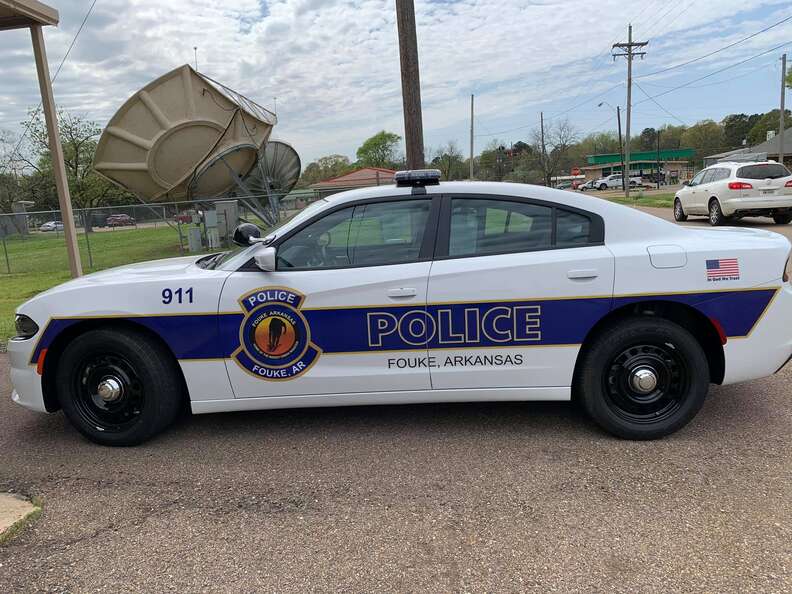
Purvis hasn’t seen the monster, but he understands the appeal. “It’s the mystery of it all,” says Purvis. “It’s intriguing. Folks that grew up around here, they know what a bobcat looks like, they know what a bear looks like. This isn’t that.”
Rachael Ironside, an associate professor at Robert Gordon University in Aberdeen, Scotland, echoes that appeal. “The supernatural is just a really compelling form of storytelling,” says Ironside. Her research centers on the links between heritage, culture, and so-called “dark tourism,” which encompasses everything from cryptid museums and ghost tours to sites of historical tragedies.
Ironside explains that monster tourism, or “legend tripping,” can also have a uniquely spiritual appeal, even for non-believers. “We've moved away from established traditional religions being the only sort of belief systems available to us,” she says. “The supernatural can be a really compelling way of [exploring belief], because it doesn't require us to stick by a set paradigm. We can build up our own beliefs.”
And while supernatural lore has always beguiled believers and skeptics alike, social media is likely to thank for the skyrocketing popularity of attractions like the Mothman Festival. “People can participate in the narrative now,” says Ironside. “You’ve got TikTokers who are going to these places and talking about them—anybody can engage with these legends from anywhere.”

Of course, monster tourism has its flaws. Every year, Point Pleasant deals with the same infrastructure issues that occur when a town’s population jumps from 4,000 to 45,000 overnight. “Everyone who lives here is working to handle the crowd, trying to find places for them to park, places to use the bathroom,” says Bellamy. “We have to bring in all these food vendors, and they pack our Main Street from one end to the other.”
He worries that local businesses are sometimes obscured by the outsiders, though the town is taking steps to make sure everyone benefits equally from the festival. Even outside vendors slinging Mothman keychains will soon have to apply for a city license. Overall, though, Bellamy welcomes the attention—as do residents of other towns impacted by monster tourism.
Terry Purvis, of Fouke, just wishes he could thank the monster in person. “I’d sit down and have a beer with him,” laughs Purvis. “Grill him up a steak. He helps our town.”