
A Time-Travel Road Trip into Virginia’s Colonial Era
From Washington D.C. to the Virginia coast, take a journey through Monticello, Mount Vernon, and living history museums full of costumed interpreters

As the United States approaches its 250th anniversary in 2026, the country’s semiquincentennial (an anniversary that sadly lacks the pithy brevity of 1976’s bicentennial) is already slowly crashing over the country in waves of red, white, and blue. Massachusetts has marked the anniversaries of the Boston Tea Party (1773) and Paul Revere’s famous ride (1775). The U.S. Army threw a birthday bash in D.C. And plenty more former colonies and communities will get in on the action in the coming months.
But there’s nowhere better to learn about the country’s roots than Virginia, the home of the first permanent English settlement at Jamestown, the final battle of the Revolution at Yorktown, and the historic homes of George Washington and Thomas Jefferson. To go with these historic sites, the state also boasts living history museums like Colonial Williamsburg and the Frontier Culture Museum, where costumed interpreters bring history to life.
The land of Virginia tells so much of the nation’s story: the forests and rivers that saw the earliest interactions between English settlers and Native peoples, the ports that received the first enslaved Africans in the English colonies, the cities and farms that became a battlefield over independence. Short of a time machine, a road trip through the state is an ideal way to better understand where the U.S. came from on the anniversary of its birth.
Who am I: I’m an editor at Thrillist and Eater. I’ve heard about Virginia’s historic colonial sites for years from my father, an historian of early America, and my aunt and cousin, who make an annual pilgrimage to Colonial Williamsburg. Of course, as an Eater editor, I couldn’t go on a road trip without finding some great meals along the way too.
The soundtrack:
1776 (Original Broadway Cast Recording)
What to pack:
A People’s History of the United States by Howard Zinn
Passport To Your National Parks
The map:
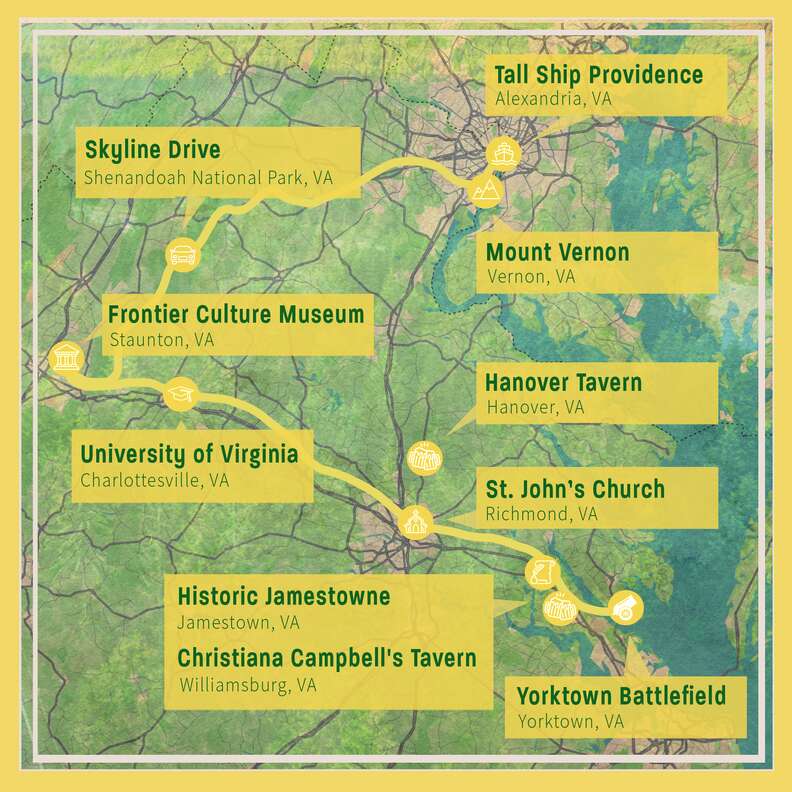
Day 1: DC to Staunton
Distance: 200 miles
Get an early start and drive down to Alexandria just south of D.C., where you can fill up for a long day with brunch at the Royal, a recently revamped century-old spot serving items like chicken and waffles with chorizo gravy and bananas Foster French toast. Then walk off the meal around Old Town Alexandria’s cobblestone streets and beautiful waterfront, where you’ll find plaques about colonial history on the African American Heritage Trail and the Tall Ship Providence (currently under repairs in Maryland until mid-July), a sloop from 1769 that served as the flagship of the Rhode Island Navy during the Revolutionary War.
Once the river breezes have sufficiently tussled your hair, hop back in the car for a 20-minute drive to Mount Vernon, where you can see not only the first president’s residence but also wander among the grounds, his farm, various outbuildings (the salt house, the dung repository), and slave quarters. The mansion is currently being restored ahead of the semiquincentennial, repairing the wear from millions of sneakers and baby strollers over the years, so tours of the building are limited to only a few rooms for the foreseeable future, so consider an alternative tour that takes guests into other buildings on the estate.

take this home
From here, it’s a 90-minute drive out to lunch at Patty O’s Cafe, the latest project from chef Patrick O'Connell of the three-Michelin-starred Inn at Little Washington. After you refuel on curried chicken salad or a black bean burger, pop over to the Thornton Gap entrance of Skyline Drive, a national parkway that weaves its way south through Shenandoah National Park, providing stunning views of Virginia in all directions. (Even if you just plan to drive through, you’ll need to purchase a week-long park pass.

Stretch your legs:
Skyline Drive provides access to a number of great hikes, including the popular Dark Hollow Falls Trail (short, but steep and rocky).
Take the drive all the way to its terminus at Rockfish Gap and turn west to Staunton, where you can splurge at two-time James Beard semifinalist Ian Boden’s much-hyped tasting-menu spot Maude and the Bear or the chef’s original, more relaxed spot, the Shack. For something even more casual, check out the much-loved Gloria’s Pupuseria.

Stay the night

Day 2: Staunton to Richmond
Distance: 125 miles
If your hotel doesn’t offer breakfast, kickstart the day at Reunion Bakery & Espresso before heading over to Staunton’s Frontier Culture Museum. On the grounds of the sprawling outdoor living history museum, you’ll find 17th- and 18th-century-style West African (Igbo) and European (German, Irish, English) communities, contextualizing how these peoples lived before their move west; there are also structures representing their lifestyles in the American colonies and states, along with an Indigenous (Eastern Woodlands) village. Costumed interpreters at each station will tell you about everything from Igbo ekwe and udu drums to Indigenous fur trade in the Americas.
Get back on the road and make your way 35 miles east to Charlottesville, home of the University of Virginia. The campus’s Academical Village area, designed by Thomas Jefferson, is a UNESCO World Heritage Site. In the shadow of Jefferson’s Rotunda building, you’ll also find the Memorial to Enslaved Laborers, constructed in 2020 to acknowledge the enslaved people who realized Jefferson’s architectural vision.
After wandering campus, head nearby to lunch at the Ridley, the restaurant at the Draftsman Boutique Hotel named for the first Black graduate of UVA, which serves riffs on classic Southern dishes. Or wander up to the Dairy Market foodhall, where stalls offer a range of Himalayan momos, Latin American street food, and wood-fired pizza.
After seeing UVA up close, get a different view of the campus from Monticello, Jefferson’s estate, just a quick drive outside town. A tour of the interior reveals some of Jefferson’s own inventions and design ideas, while the ground level provides details on the Getting Word Project, an oral history program documenting the families and descendants of enslaved people at Monticello.

Worth the detour:
Grab a drink at Hanover Tavern, which has counted George Washington, Lord Cornwallis, and the Marquis de Lafayette among its patrons over the last couple centuries.
End the day in Richmond, about an hour to the east, where you can see the Virginia State Capitol building, also designed by Jefferson, and St. John’s Church, where Patrick Henry gave his famous “Liberty or Death” speech in 1775. Top it off with a seafood dinner at Alewife, Rappahannock Oyster Company, or Birdie’s.
Stretch your legs:
If it’s still light out after dinner, wander up to Libby Hill, where you can see the view of the James River that gave Richmond its name (it resembles the view of the Thames from Richmond, England).

Stay the night

Day 3: Richmond to Yorktown
Distance: 75 miles
Classic and nouveau deli fare at Perly’s (corned beef hash, babka French toast) makes a great choice for breakfast before hitting the road. Then it’s a quick, hour-long drive over to Virginia’s Historic Triangle, which comprises Jamestown, Williamsburg, and Yorktown.
Start at the Jamestown Settlement, which provides plenty of insight into life in the first English settlement in America. In the indoor museum, exhibits give nearly equal weight to the Indigenous Powhatan communities who inhabited the region, English settlers, and the Africans from modern-day Angola who became the first enslaved people to arrive in Jamestown in 1619. (Don’t miss the exhibit about cultural representations of Pocahontas over the years.) There’s also an outdoor living history section, including several recreation ships that you can tour, where interpreters help unpack 17th-century lifestyles. When you’re done, pop over to Historic Jamestowne nearby to see archeologists at work uncovering the actual settlement.

Take the Colonial Parkway over to Colonial Williamsburg, the world’s largest living history museum. Opened 100 years ago with money from John D. Rockefeller Jr., the museum recreates 18th-century Williamsburg down to the nails forged by the local blacksmith. Start in Merchants Square with lunch at the Cheese Shop, a modern, family-run favorite that often attracts a line out the door for its sandwich menu. Then grab a day pass from the Lumber House and stroll down Gloucester Street popping in to see the wigmaker, bookbinder, apothecary, or any other shops that attract your interest. Don’t miss the daily performances at the courthouse (where visitors take on the roles like justices and plaintiffs), the drum and fife corps (which marches through the middle of town each afternoon), or the Bray School (a school for free and enslaved Black children founded in 1760). You might even run into famous figures like George Washington, the Marquis de Lafayette, or James Armistead Lafayette, who will answer any question you like about their lives in character — and eagerly break character to discuss the historical sources backing up these portrayals.

Take this home
Finish off your tour of the triangle at Yorktown, just down the Colonial Parkway. The American Revolution Museum at Yorktown will teach you all the nitty gritty about the Revolutionary War and its final battle. Just outside, in the recreated army encampment, you can catch cannon and rifle demonstrations, peek inside a few tents, and chat with the field surgeon about whatever ails you. After exiting the museum, use the Yorktown Tour Guide app to take a driving tour of historic locations critical to the Siege of Yorktown.
For dinner and a bed, swing back around to Colonial Williamsburg. At the King’s Arm Tavern and Christina Campbell’s Tavern (the latter was a favorite of George Washington), recipes are drawn directly from 18th-century cookbooks. Note: Restaurants and shops in CW close early.

stay the night

If you have four days…
You could spend an extra day or two bopping about Williamsburg. That would give you a chance to pop over to the campus of William and Mary next door, where you can poke around the Wren Building, the oldest standing college building in the U.S. You should also swing by the Abby Aldrich Rockefeller Folk Art Museum and dine at the Fat Canary, the restaurant attached to the Cheese Shop, if you get the chance.
If you have five days…
If you’re ready to head out of Virginia, snake your way down North Carolina’s Outer Banks to Roanoke Island, where you can eat fried seafood and catch a performance of The Lost Colony, a long-standing show about the mysteriously vanished settlement.