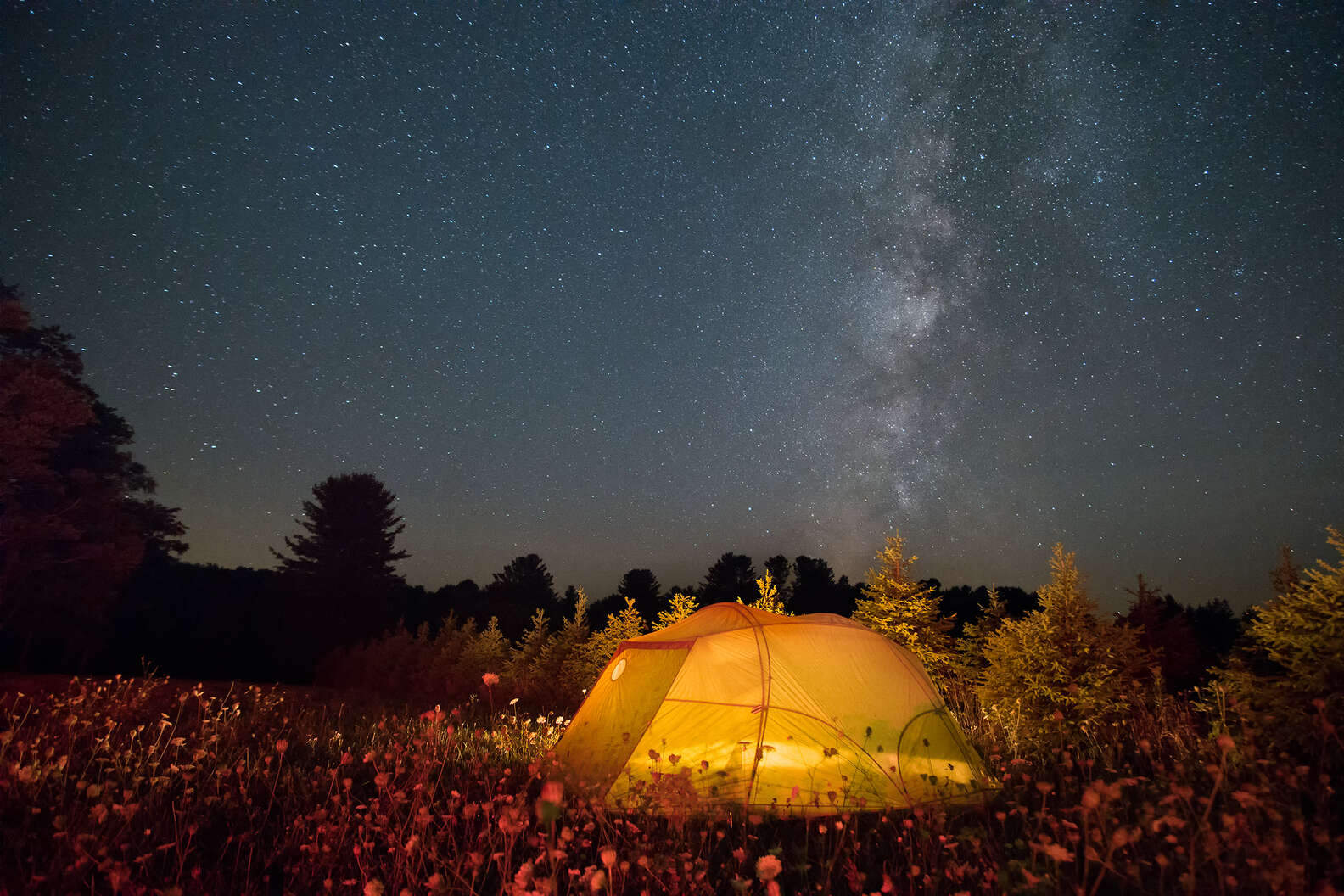
The Best Places to Stargaze in the U.S. Right Now
Two major meteor showers are coming up soon, here’s where to see them
Electric lights have given us a lot, from nightlife to motion pictures to spelunking, but damn if the overwhelming light pollution of cities doesn’t make stargazing tricky. On a day-to-day basis, most of us are unable to enjoy the vastness of the cosmos with the naked eye. You may not acutely feel this loss very often, but all of a sudden it matters: Over the next few weeks, there are two major meteor showers, the Lyrids and Eta Aquarids, that will be visible in the Northern Hemisphere — assuming you can get somewhere dark enough to see them. It’s prime time to escape the city and head to some of the best stargazing sites in the U.S.
The Lyrids are ongoing until April 25, and will peak on April 21 and 22. The center of the shower is generally located in the northeastern section of the sky, around the constellation Lyra for which the shower is named. Eta Aquarids runs from April 19 until May 28, and is set to peak around May 6. It’s primarily a Southern Hemisphere phenomenon, but will still be visible in the United States, especially towards the southern horizon just before dawn.
Your best bet for seeing these showers in all their glory is to visit a Dark Sky Place, which are among the best places to stargaze in the world, as certified by the International Dark Sky Association. What began in 1988 as a grassroots movement among astronomers in Tucson is now an international landscape. There are more than 200 certified Dark Sky Places spanning 22 countries, with more communities working all the time to get officially certified by the IDA’s standards—a process that can take up to three years.
Dark Sky Places fall under five designations: sanctuaries, the most remote and unpopulated dark areas; reserves, sparsely populated centers where policies are enacted to keep the skies unpolluted; dark sky parks, public and privately-owned lands, including many national parks; urban night sky places, located near cities; and international dark sky communities, cities and towns that enact policies to combat light pollution and educate their citizens about dark sky practices.
Along with the Rocky Mountain Star Share in June, an annual extravaganza in Colorado on 35 acres of land with speakers, camping, and massive telescopes, the IDA has declared April 21 through 28, when the Lyrids and Eta Aquarids showers will both be lighting up the night, to be this year’s official Dark Sky Week. It’s the perfect time to make your first — or thousandth — visit to one of America’s best Dark Sky Places.
The coolest Dark Sky Places in the U.S.
Across the 156 Dark Sky Places in the United States, you’ll find friendly amateur astronomers and ample opportunities to gaze uninterrupted into the heavens. Consider picking up a red light headlamp—a hands-free way to illuminate your path without compromising your night vision. Check the weather forecast, bring layers and plenty of water, tell someone where you’re going, and don’t forget to look down every once in a while.

Cherry Springs State Park
Pennsylvania
The East Coast is a mess on the light-pollution map, but that doesn’t mean stargazing is impossible. Cherry Springs State Park comes with its own astronomy field, and it even offers private tours. It’s open year-round, and you can check when the skies overhead are expected to be clearest. There are star parties, but they do fill up in advance so make sure to register well ahead of time if you have your heart set on one. You might even see the northern lights.

Katahdin Woods and Waters National Monument
Maine
Speaking of the East Coast, Maine’s been busy. Pre-pandemic, there were no Dark Sky Places in the state, and now there are two. In May 2021, the Appalachian Mountain Club’s Maine Woods was designated an International Dark Sky Park. Its 300-square-kilometers of land within Maine’s famed 100-Mile Wilderness includes a section of the Appalachian Trail.
This follows 2020’s designation of the Katahdin Woods and Waters National Monument as a Dark Sky Sanctuary, one of only 15 such Sanctuaries in the world and the only one east of the Mississippi. A haven for daytime exploration, when night falls you can see the stars just as brightly as the Indigenous Wabanaki did 11,000 years ago. And each October, they host a special Stars over Katahdin celebration.

Jackson Lake State Park
Colorado
In 2020 Jackson Lake State Park, which is just 90 miles from Denver, became the first state park in Colorado to be designated an International Dark Sky Park, fitting right in with the state's whopping nine official Dark Sky Places. It was already a go-to for amateur astronomers with meet-ups from July through September, but advocates removed street lamps, updated light fixtures, and obtained a Celetron telescope for public use. Stargazing is especially good from the sandy beaches around the massive reservoir, whose reflective surface mirrors the Milky Way.

Big Bend National Park
Texas
The bend isn't the only thing that’s big in one of America’s most underrated national parks—the number of stars you can see here is absolutely massive. Big Bend is an ultra-remote spot in far West Texas, where you’ll find yourself with plenty of peace and quiet as you hike through desert canyons, marvel at the Chisos Mountains, or kayak down the Rio Grande. But don’t forget to save some energy for after dark: Big Bend’s extreme isolation makes it the least light-polluted of all the national parks in the lower 48. Park yourself anywhere beneath its 1,112,000 acres of dark skies for a night and take it all in.

Goblin Valley State Park
Utah
Utah punches well above its weight in terms of stargazing—between Arches, Zion, Bryce, Capitol Reef, and Canyonlands, the state might as well just be one big-ass national park. But don’t overlook the state parks, either: They give the big boys a run for their money, and none is more surreal under a blanket of stars than the hoodoos and otherworldly formations at Goblin Valley, which happens to also be a certified International Dark Sky Park. Here, the aural glows trick your eyes into thinking that there are creatures lurking around the spires. Or maybe it’s just David Bowie. Either way, you can check Goblin Valley’s dark sky forecast here.

Grand Canyon National Park
Arizona
Is it the best national park in America? That’s debatable. It is the most recognizable, and an extraordinary place to stargaze. A few years ago, the Grand Canyon Village began retrofitting all its lighting to be more dark sky-friendly, and in 2019 was rewarded with full Dark Sky status. There’s an annual Grand Canyon Star Party held each June, and the Desert View Watchtower is a popular spot for capturing the Milky Way with astrophotography. On a full moon night, take a ranger-led hike along the rim, or on other nights, a ranger-led constellation tour. Here’s how to plan your visit.

Death Valley National Park
California and Nevada
Death Valley is the largest Dark Sky National Park in the country. You can set up shop at designated campgrounds and gaze upwards; the Mesquite Flat Sand Dunes is an otherworldly spot to watch the stars come out. Bring a flashlight and be cognizant of the extreme heat, which on summer nights can hover above the 90s. Come spring and winter, you’ll find a robust program of ranger-led astronomy activities, like the big ol’ star party they throw each year around March, the Death Valley Dark Sky Festival, a collaboration between the park and NASA.

Cosmic Campground
New Mexico
Cosmic Campground sits within Gila National Forest, and was the first Dark Sky Sanctuary not just within the National Forest System, but anywhere in North America. It’s so dark you won’t find any artificial light sources for 40 miles. There’s a star party each spring, but don't stress if you miss it—this is a particularly great place to go to be alone. The forest is free to enter and open year-round; you can check out the campground’s stargazing tips here. The camping amenities are bare-bones, but isn’t that what you’re looking for? Drive southeast to White Sands National Monument, and you’ll find more excellent stargazing sites complete with additional star parties, too.

Massacre Rim
Nevada
Two volcanic plateaus are encompassed in the Massacre Rim Wilderness Study Area, which in 2019 was designated a Dark Sky Sanctuary. A 1,200-foot-tall escarpment descends into a valley, and it’s so dark you can see shadows cast by the light of the Milky Way. It’s a little tricky to get there—the region is remote, the roads rife with wildlife, and rough and rocky to navigate (they recommend having a spare tire on hand). But, hey, that just means fewer tourists. For all of those reasons, Massacre Rim is particularly popular with backcountry hikers. It might not be your pick if you’re looking for more of a park ranger-led star scene, but if getting away from it all fits the bill, add it to your list.
Natural Bridges National Monument
Utah
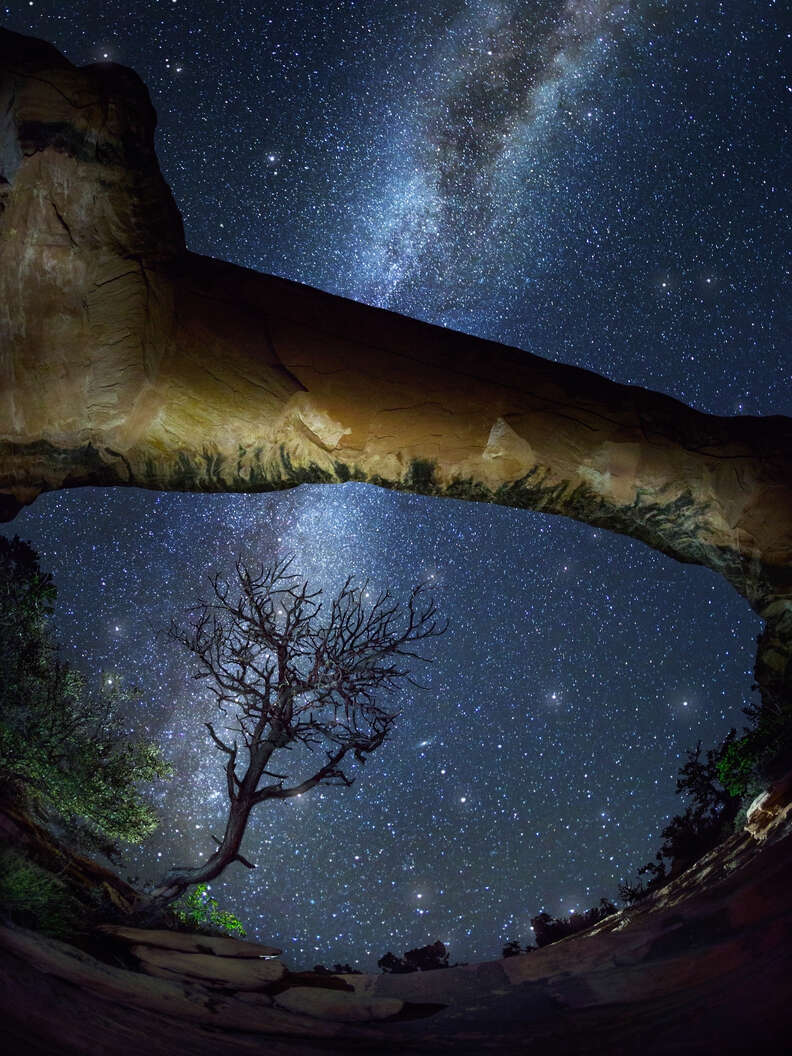
Like its state parks, Utah’s national monuments often hide in the shadows of its big five national parks. As such, only about 100,000 people visit Natural Bridges each year, and most of those folks don’t stick around once the sun goes down. Which is unfortunate—Natural Bridges became the first international Dark Sky Park in 2007, because it has some of the absolute darkest skies in the country and countless astronomy events held through the summer. At night, the sky positively explodes with stars and celestial bodies, and the canyon walls are pitch black in contrast to the Milky Way rising over Owachomo Bridge.

Great Sand Dunes National Park
Colorado
Great Sand Dunes is one of our most underrated national parks, a reprieve from the canyons and arches of the Southwest. You know those iconic movie scenes where our hero marches up a giant sand dune under a brilliant scene of stars? This is basically that. A few tips: Check their events website for night programs like constellation lectures and quicksand survival stories. Skip the contact lenses—it would make for a particularly excruciating experience on a windy night. And for a true once-in-a-lifetime experience, bring your own sand sled or sand board (the park doesn't rent them, but they're permitted in designated areas) for a particularly surreal evening surfing beneath a galactic glow.
Vanita Salisbury is Thrillist's Senior Travel Writer. She'll get to the stars, no billionaire-owned spacecraft needed.