10 Abandoned Subway Stations in NYC You Can Still Visit
Your metro card won’t work here.
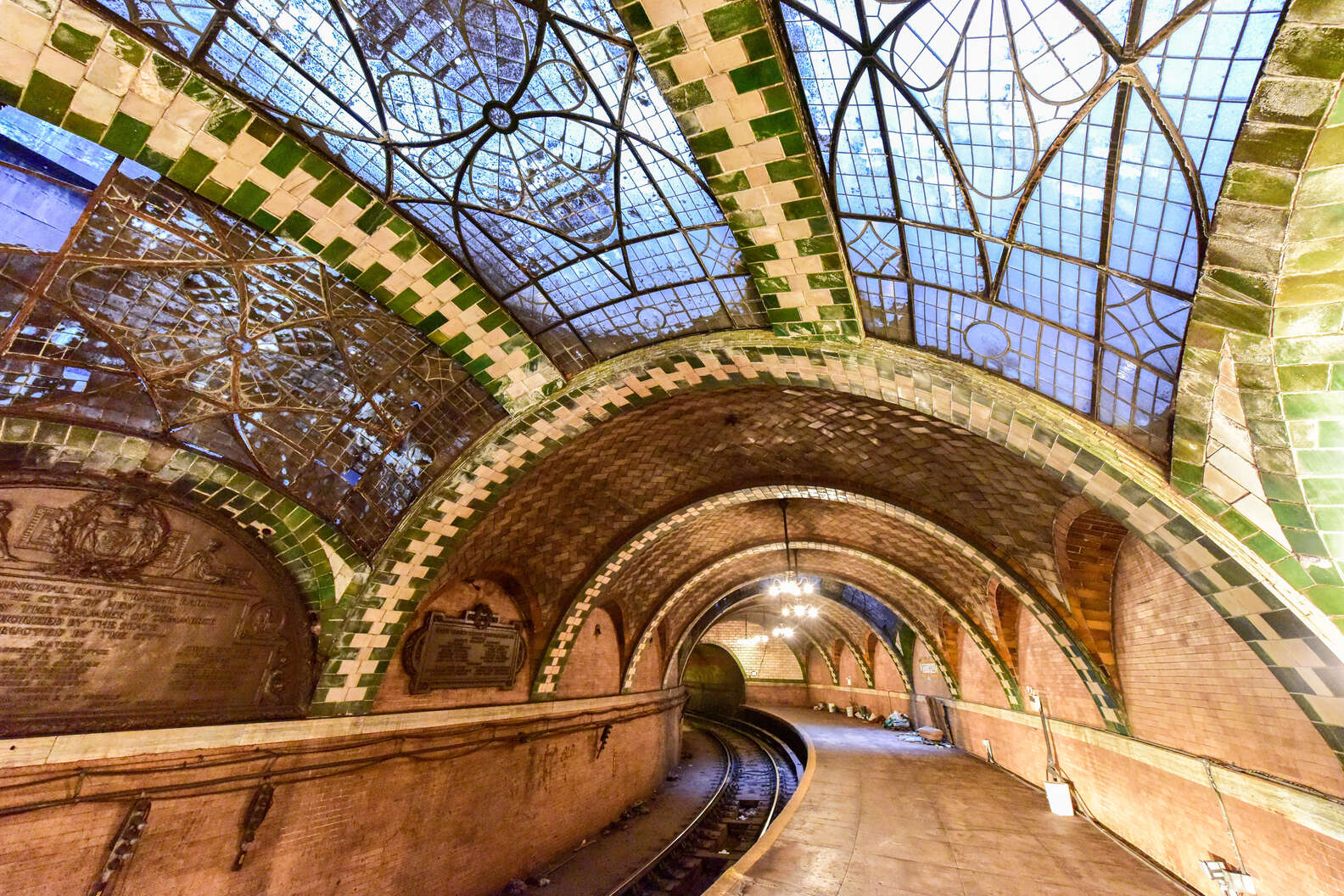
At 120 years old, New York City’s subway is one of the world’s longest-operating public transportation systems. With a total of 472 stations, 36 lines, 665 miles of track, and 5,225 million riders on average per day, it also claims the titles for both the busiest stations and the most stations in the country.
Naturally, changing city layouts and outdated technology, has forced some of these stations to be retired over the years. And if the old stations weren’t demolished or renovated, then they still stand frozen in time underneath the city concrete. Although a bit worse for wear with cobweb-covered ceilings and rusted rails, there’s still evidence of what was once a magnificent gateway of transit. From an exemplar of turn-of-the-century architectural glitz to an unfinished gateway-turned-illegal art gallery, here are the most fascinating abandoned subway stations in NYC.

Old City Hall
Financial District
When NYC’s subway system first opened in 1904, the stop at City Hall was widely considered the crème de la crème of stations. Designed with tiled arches and ornate skylights by engineer Rafael Guastavino, it was one of 28 stops that ran from City Hall to 145th Street. By 1945, updated subway cars could no longer fit on the rails, so it was shut down and replaced with a newer City Hall station for the R and W lines. But, the former station is not completely lost: The New York City Transit Museum offers ticketed tours of the historic station.

Court Street
Downtown Brooklyn
Unlike other decommissioned stations, Court Street remains fully operational—thanks in part to its reincarnation as the New York Transit Museum. To this day, vintage trains are moved into and out of the museum using the station’s tunnel and the outer tracks of the neighboring Hoyt-Schermerhorn Street stop. The station opened in 1936 as part of a plan where local trains would operate within boroughs and express trains between them. This eventually proved ineffective and was closed in 1946. In the 1960s, the inactive station made its way into movies, most famously the 1974 thriller The Taking of Pelham One Two Three. In 1976, the station reopened to the public for The New York City Transit Exhibit in honor of the United States Bicentennial. The exhibit was so popular that it stayed open and eventually morphed into a full-fledged museum.
Dean Street
Bedford-Stuyvestant
This twice-closed elevated station in Brooklyn may have been doomed from the start, earning its distinction, as the New York Times once said, “often grim than glorious.” First opened in 1897, it went relatively unused and was closed two years later. Local property owners were so outraged that the station was opened again in 1901 and, although it continued to lose traffic to the nearby Franklin Avenue station, it was upgraded to accommodate six-car trains in 1924 along with the rest of the Franklin Avenue line. The station gradually fell into disrepair until it was shuttered in 1995.

Myrtle Avenue
Downtown Brooklyn
Myrtle Avenue was once a local station on the Brooklyn-Manhattan Transit line. Closed in 1956 to allow the reconstruction of a flying junction that would increase the line’s capacity, its southbound platform was removed and its northbound platform was abandoned. Since 1980, the remaining platform has been home to Masstransiscope, an art installation by filmographer Bill Brand. The work consists of 228 hand-painted panels that cover the 300-foot-long station. Hop on a Manhattan-bound B or Q train at the DeKalb stop and, as the train moves in front of the panels, you’ll witness the illusion of a 20-second animated movie. Check out this video for a behind-the-scenes peek at the installation’s 2008 restoration and to hear from the artist himself.

Sedgwick Avenue
Highbridge
The Sedgwick Ave station opened in 1918 as an extension of the 9th Avenue El, which was NYC's first elevated railway famous for its 90-degree "Suicide Curve" at 110th Street. The Bronx station was built as a point of transfer from the El to Metro-North predecessor, the New York Central Railroad. It was also an important stop along the shuttle between the old Polo Grounds in Washington Heights and Yankee Stadium. The shuttle was discontinued in 1958 when the New York Giants jumped ship to San Francisco, making the station obsolete. Its elevated steel structure was removed, but the platform and tunnel remain. To take a look, hop on the 4, B, or D train to 161 Street, and walk across the footbridge over Sedgwick Avenue and the Major Deegan Expressway. There, you'll be able to make out the ground-level portions of the old station hiding under the highway.

South 4th Street
Williamsburg
Beneath Williamsburg’s South 4th Street lies a six-track station that was once intended to be a major point of transfer for the IND Second System. When its construction was halted by World War II, it was left without tunnels or lighting and its stairwell and walls unfinished. In 2009, the station was brought back to life when street artists PAC and Workhorse invited 103 peers from around the world to adorn the space with their own creations, mostly large murals painted directly onto the barren walls. One of the largest exhibitions showcasing this kind of work in a single space, The Underbelly Project was illegally mounted and reachable only, as one intrepid New York Times reporter explained, by “waiting at an active station’s platform until it’s empty, slipping from it into the damp and very dirty no man’s land beyond, and traversing that to get to the old station’s entrance.” The space has since been sealed off by the MTA who claims to be protecting the artworks, but that hasn’t stopped some more recalcitrant urban explorers from attempting to sneak in. If you’d prefer to get a glimpse of the space without getting arrested, check out this video.
Worth Street
Civic Center
As one of the city’s original subway lines, the Worth Street station first debuted in 1904. Amid subway renovations during the late 1950s and early 1960s, the station was deemed inconvenient and shut down. You can still catch glimpses of this relic though. If the 6 train moves slowly enough between Canal Street and Brooklyn Bridge, you can spot the station’s name on its tile-clad support columns, as well as a few terracotta W's adorning the walls—both tributes to the Mexican-American War major-general William Jenkins Worth. Most of this is covered in graffiti art these days though.
18th Street
Gramercy Park
The 18th Street station near Gramercy Park is yet another abandoned station turned spray painted-art canvas. When the neighboring 14th Street-Union Square and 23rd Street stations underwent platform extensions in 1948, the station shuttered its doors. But because of its fairly standard design, it was continued to be used for publicity photos. Its two salient features—a naturally lit glass ceiling and a set of ornamental motifs—come courtesy of Heins & LaFarge, the same Gotham-based architectural firm behind the opulent City Hall stop.
76th Street
Queens
Most of NYC’s abandoned subway stations sport at least a minor air of mystery, but this one’s very existence has been hotly debated for years. “The station cannot be found on any map, however, nor can it be reached by any train,” the New York Times wrote in 2003. The 76th Street station was rumored to be part of a plan to extend the A line to 229th Street in the Cambria Heights area of Queens. According to some, it lies behind a tunnel that was sealed off in 1952—meaning that even if it does exist, it’s near-impossible to access.